Óráid an Uachtaráin 2020

Uachtarán Chumann Lúthchleas Gael John Horan.
A chairde uilig.
Is cúis áthais dom a bheith i mo sheasamh ós bhur gcomhair arís i bPáirc an Chrócaigh.
It hardly seems like 24 months since I had the good privilege and honour to stand here in front of you and address you as Uachtarán Chumann Lúthchleas Gael for the first time.
It is no less an honour to do so again today after another solid and satisfying year when the best of the GAA was on view for all to see.
More than any other single thing, serving our members and clubs as GAA President provides remarkable insights into the workings of our 136-year-old organisation.
An organisation that continues to evolve, thrive and influence Irish society and so many people, not only across the island, but also those dotted around the globe in small pockets who are connected by their shared interest in our games and culture.
The metrics for measuring success in the calendar year that was 2019 will probably differ depending on what role or position you occupy in the GAA.
However, our relevancy can be linked to two crucial statistics – how many people participate in our games and activities – whether it be football, hurling, handball, rounders, Scór or an teanga náisiúnta, and how many people are attracted to attend our games when they are played.
On both fronts we continue to excel, not in a way to cause complacency - but in a manner which should provide confidence and belief that so much of what we do continues to successfully safeguard the future and the direction of the Association.
We do however, operate in changed times.
We need to be cognisant of societal change and the challenges that brings.
We need to be conscious of effecting positive change in how we organise our games and run our affairs, striving always to be better and to learn from instances when the ball is dropped.
These are not lessons specific to the GAA alone - but more akin to life lessons.
While the glitzy days at Croke Park may understandably capture the imagination for many, over the course of a given year my interactions with clubs and members far away from the glare are the things that I take with me.
The drive and self-sufficiency of so many of our communities is something to behold and their zeal and zest for bettering themselves, whether through the games or through facilities, is something that continues to amaze me to such an extent that I sometimes wonder what an Ireland without the GAA would look like.
Recently I visited the juvenile sections of Aghnamullen and Drumhowan, two clubs in Co. Monaghan where the strength and vibrancy of our games and the GAA was very much in evidence.
The energy, passion and goodwill on show on such occasions is what sustains us and I know from countless similar visits that the scene that greeted me that night is one that is replicated in villages, townlands, towns and cities throughout the organisation.
Táim breá sásta go bhfuilimid fós lándáiríre mar eagraíocht faoi na cuspóirí agus na bunaidhmeanna a bhí leagtha amach ag ár mbunaitheoirí thiar in ochtdéag ochtó ceathair.
Is iontach an rud go bhfuil áit lárnach fós ag ár dteanga agus ag ár gcultúr sa chumann agus molaim go hard an obair den scoth atá ar bun idir óg agus aosta le Scór agus leis an teanga náisiúnta lenár nOifigeach Gaeilge, Jamie Ó Tuama.

GAA Congress 2020 at Croke Park.
GOVERNANCE
Never before has governance been more important in how we organise our activities.
What exactly is governance?
It’s adhering to certain standards of compliance and transparency, doing the right things the right way and ensuring that the GAA is never left open to accusations of shoddy or haphazard practices, whether they be financial or otherwise.
This does not just apply to the offices at Croke Park. It concerns us all and without scare mongering, slip ups will be scrutinised and publicised and our amateur, volunteer ethos will not be a defence.
We have been involved in a process for a considerable time to examine if we are fully fit for purpose in this regard and will continue in this vein.
It is our intention shortly to enlist external assistance and expertise to ensure that the steps and changes we are overseeing will help us achieve our aims in this area.
Good governance cannot be a slogan.
It needs to be something that is self-evidenced by actions and not merely words.
Governance was the central theme of the work which took place last January when more than 250 officers from across the 32 counties attended our county officer training day at Croke Park and our commitment in this regard should be under no doubt.
FINANCE
Congress takes place against the backdrop of a very strong financial return for the Association in 2019.
We had a successful year.
In the last few years we have increased the dividend returned to the GAA from Croke Park Stadium and it is important to highlight the role played by our supporters and the impact of the games we stage in that increase.
A large proportion of this dividend comes from the sale of premium seats for our matches.
We promised to use any additional income for clubs, county boards and World GAA. I am delighted to be in a position to be able to say that we achieved all of our targets in this regard.
Some commentary likened the financial report as having the GAA laughing all the way to the bank. Nothing could be further from the truth of course.
The GAA has never existed to create a mountain of reserves. The wealth of the GAA needs to be something that can be seen in our numbers at work on the ground.
Numbers like the 365 coaches working at games promotion and development are examples of what is important.
Likewise, the more than 500 clubs receiving financial aid towards their redevelopment of pitches and facilities.
And so too, the 6,000 plus number of club players who required a share of the €8m given in financial assistance in their recovery from injury.
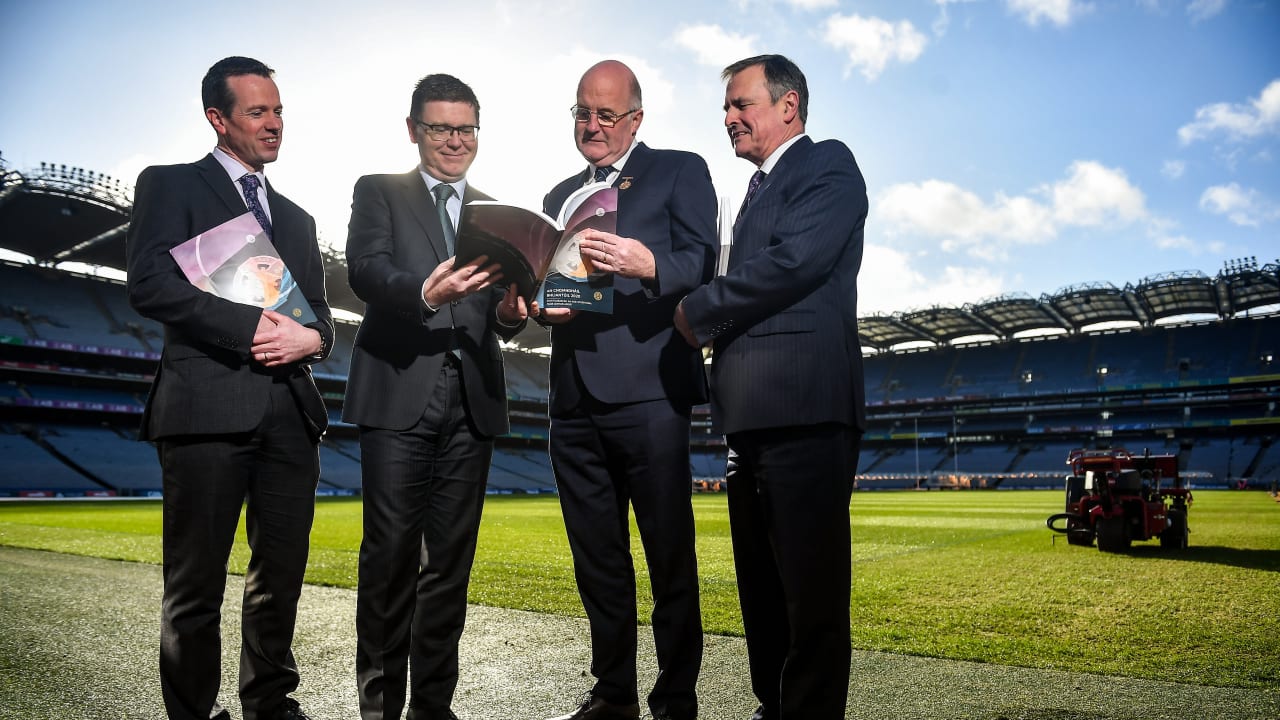
Uachtarán Chumann Lúthchleas Gael John Horan alongside, from left, Director of Finance of the GAA Ger Mulryan, Ard Stiúrthóir of the GAA Tom Ryan, and Commercial Director of the GAA and Croke Park Stadium Director Peter McKenna.
It’s worth pointing out again that of the 360 games we organise centrally every year, less than 60 generate a surplus. In a nutshell, that means that these games provide the finance to run the Association.
That is not to question the validity of staging the remaining games – we stage them and run the competitions they form part of because the player that plays in our smallest competition is as valuable to our organisation as the player that adorns Croke Park on All-Ireland final day.
As a not for profit organisation, our goal is to reinvest and reinvest significantly in the development and promotion of Gaelic games and to provide assistance to our clubs and counties to be able to perform.
A word of caution is needed, however.
We are unlikely to hit the same level of €74m in revenue in 2020 which we achieved last year, and people need to be aware of this and budget accordingly.
There are no concerts planned for Croke Park this year and we cannot bank on an All-Ireland final replay either. This will bring our figures down by about €6m.
HEALTH AND SAFETY
Rising insurance costs is a topic of national debate and we have seen how the business community has struggled and many other sectors too.
The GAA, of course, is not immune to these issues.
The success of the pilot project staged in Monaghan in the area of health and safety within clubs has created a major awareness about policies and procedures and practices in this regard.
There has been a huge uptake in the number of counties looking to benefit from a similar body of work at making our units more aware and more vigilant.
The recent figures released show that claims totaling €8m were made against the Association last year for events which were not related to the promotion of Gaelic games.
We cannot continue to pay for the mistakes of others.
It is a source of great pride to be able to travel virtually anywhere in Ireland and see that the local GAA facility is very often the jewel in the crown of the local community.
We put all of that at risk when we take chances in the area of insurance and health and safety and leave ourselves open to claims – particularly for events which have nothing to do with what a GAA club should be.
GPA
We value the club players who have the wherewithal to perform to such a high level on the inter-county stage and with that respect comes a responsibility to them.
There have been difficulties around certain aspects to negotiations between the GAA and the GPA.
It is important that in bringing those negotiations to a conclusion that we create a sustainable position for our Association.
When negotiations are concluded, it is vital that ourselves and the GPA work together to lessen the demands on players’ lives and lessen the cost burden on county boards created by the inter-county game.
Neither the GPA nor the GAA at national level ‘own’ these players. They are club players above all else and their inter-county career is something that is a passing phase in what should hopefully be a life-long association with the GAA.
Whether that inter-county career is a fleeting glimmer or a sustained sunburst of brilliance, players need to feel valued and need to be able to return to their clubs to continue their GAA journey without any resentment or regret.
I believe the GAA and the GPA can work together to ensure that this is always the case.

Uachtarán Chumann Lúthchleas Gael John Horan during the GAA Annual Congress 2020 at Croke Park.
TEAM OPERATING COSTS
The Ard Stiúrthóir in his report has sounded a stark warning in the area of county team preparation costs which now stand in the region of €30m.
These rising costs have been unsustainable for some time and too many counties have been pushed to the pin of their collar to finance and fund an inter-county operation that is coming at the expense of other equally important projects in games promotion and development in their county.
This should not be seen as a commentary or criticism of players.
The emphasis on the team behind the team is out of control.
There is an industry now built up around county back room teams with experts and gurus and analysts almost numbering to as many people as there are players. Few of this cohort are aligned to the amateur ethos.
The result is that our counties combined are spending 10 times as much on preparing teams than the figure which the GAA nationally is able to commit to investing in club pitches and facilities.
Far from there being an emphasis on value for money, too much of this spending is of the ‘keeping up with the Jones’s mentality’ where counties are spending because they feel the need to keep up with the latest trend, or mimic what their neighbour is doing.
A shortened season on its own won’t seriously curtail these costs.
The area of shared services is something which might help - but is probably in its infancy.
It is hard to put a limit on a county’s ambition and it is important that we do not drive the funding of teams underground and create a covert practice.
But we shouldn’t need rules to enforce common sense.
Above all, what’s needed is a culture and a mindset change because we have already seen how this practice has started to carry over into the club game and if these costs are unwarranted and unsustainable for a county team – they are a dangerous threat to the club game.
We have commissioned an internal report on this subject, and I expect its findings to be presented to us in the summer.
PÁIRC UÍ CHAOIMH
The GAA now has a fantastic playing facility on Leeside. But lessons have to be learned by the entire Association arising out of the difficulties that arose in the redevelopment of Páirc Uí Chaoimh.
I took on the role of Chair of the Stadium Board, in November 2018, and it has been one of the biggest challenges that I have faced in my time as Uachtarán as we have worked to resolve those difficulties.
I’d like to acknowledge the work of Michael O’Flynn and John Mullins in bringing so much time and energy to helping us to turn this difficult situation around.
As an organisation, we cannot engage in future infrastructural developments without a thorough analysis of all the costs and risks involved in undertaking the project.
Proper business plans need to be put in place to ensure there is no threat to the Association, and also, we need to ensure that when such facilities are built that they also have the capacity to sustain themselves.
I want to assure the membership who have concerns and who think there will be a bail out for the difficulties at Páirc Uí Chaoimh, that this will not happen.
The resolution to the problems in Cork will be found from within Cork.
The legacy from this episode will have implications for how we approach other similar projects. Far from being a negative, I believe that will make a positive contribution to ensure we never have this problem again.

A general view of Páirc Uí Chaoimh.
FIXTURES REVIEW
Working to resolve the fixtures issue in Gaelic games is nothing new. This means that, despite what some commentators think, if it was easy to do, it would have been done a long time ago.
There are a lot of different strands that are woven into the fabric of the GAA calendar.
They are precious to each individual party. But the reality is that it is clear from the calendar that has been in place that we have had too many competitions that were spread out over too long a timeframe.
Worse still, this congestion was often calling on some players for two or three competitions on top of each other and that’s before you factor in club commitments.
The work of the Fixtures Calendar Review was a significant undertaking and I want to again congratulate Eddie Sullivan and his committee for their work and commitment to this challenge.
The detailed document which they produced has 32 proposals and recommendations which are designed to alter the calendar and create space for club and county to co-exist better than they have before and enhance player welfare.
It is worth remembering that in 2015 there were only five club-only weekends in the calendar between April and October. We currently have this up to 12 such club only weekends for the majority of counties and we have the ability to increase it to 15 weekends for the majority of counties for club only activity between April and October.
Some of the recommendations are before us at Congress. But the bulk of the review will be brought before the membership via a series of upcoming regional roadshows to engage with members and work on a list of motions for a Special Congress to be held in September.
I am urging clubs to embrace this opportunity to come together and engage and make their views known, and if needs be, there can be amendments made before motions are prepared for the Special Congress.
The invitation is there for clubs to make an impact and I hope they do not pass up on that opportunity.
TAILTEANN CUP
In ancient Ireland, our athletic and sporting prowess was celebrated every summer by the staging of the Tailteann Games, a festival that some scholars date as far back as 1600 BC.
A recent meeting of Ard Chomhairle has agreed to dedicate a new trophy for the Tier 2 senior football championship to be called the Tailteann Cup – a name that honours this link to Ireland’s sporting heritage and crowns modern day sporting heroes in one of our native games.
This competition came out of a desire from several counties to have a championship that was inclusive and not exclusive.
Far from being a radical new departure, it follows a tiered path that is well known in inter-county championship hurling, at club championship level, schools’ level and across our sister organisations where it has proven itself to be effective.
Yet, for all of that, it still does not deny a county a chance at aiming for the Sam Maguire Cup if they are good enough.
The make-up of the Tailteann Cup will still be about finding winners and establishing who is the best – but will do so with a smaller field of teams on a more equal footing.
It is vital that the marketing and promotion of this new competition delivers. In addition to having its own all-star selection, it is our intention to have the semi-finals and the final of the Tailteann Cup shown live on RTÉ television from Croke Park.
I feel this competition is a good step forward and I hope everyone involved gives it a chance.
TALENT ACADEMY REPORT
It is two years now since I stood here before delegates and spoke about my fears for the direction of our talented young players within the Association.
Having spent so many enjoyable years working with and developing young players as part of county minor teams, I was alarmed at the manner in which elitism was threatening to take hold in the development of our next generation of players.
More than that, I was appalled at the culture of dispensing with young teenage players from academy and development squads and the ease with which players could be cast aside and left feeling like failures before they had even come out of minor level.
One of the most satisfying and rewarding bodies of work which has been successfully undertaken in my time as Uachtarán is the Talent Academy Report which was launched publicly last December.
A hard-working and experienced committee, expertly led by Michael Dempsey, took a little longer than was anticipated to finalise their report - but this was due in large part to evaluating the enormous body of work which was undertaken.
This report will now drive our approach within coaching and games structures and a positive change in favour of a CCCC for juvenile games will start bearing fruit at improving the whole area of underage participation and in tackling in particular elite squads.
The key to this report is that it puts the club first and foremost and treats these players as club players and not part of an elitist system.
Speaking at its launch, Brian Cuthbert urged all of us who are working with young players to grasp this nettle and we have nothing to be afraid of in taking on this challenge.
WORLD GAA
One of the great privileges of being Uachtarán is being afforded the opportunity to travel abroad and see the growth and expansion and impact of our club network overseas.
We have more than 400 GAA clubs operating outside of Ireland. The India Wolfhounds are among our newest members, so too, are clubs representing Moscow and Cambodia and Bermuda.
The men gathered in the billiards room of Hayes’ Hotel founding the GAA more than 130 years ago would surely never have imagined that!
Wherever they go, the Irish take our games and love of culture with them. These clubs support them and sustain them. Whether it’s a support structure in a business, social or a sporting context this network is vitally important and it is the same the world over.
Increasingly, our games are proving popular with locals in these far-flung destinations who are drawn as we are to the skills and thrills of Gaelic games.
The successful GAA World Games staged in Waterford last summer was another massive highlight with the finals staged in glorious sunshine at Croke Park. Some 60 per cent of the almost 90 teams taking part were made up of non-native Irish.
World GAA under the direction of Niall Erskine and his committee and through Aine Gibney in Croke Park are due our gratitude for their work at maintaining this great success story.

Ireland will play Australia in International Rules again in 2020.
AFL
Next November the GAA will assemble some of our finest Gaelic footballers to take on the professional elite of the AFL in the two-test International Rules Series staged at Páirc Uí Chaoimh and Croke Park.
It will be as big an honour then as it always has been, a fine achievement for the Association to be able to produce players who can follow in the footsteps of so many great players who went before - and all the way back to the Meath team of the late 60s who pioneered this link up with Aussie Rules and which has given players in both countries a unique opportunity to represent their country.
Since the 1980s there have been a small number of Gaelic footballers who have had the chance to cross over and try their hand as professional Aussie Rules players.
It has been an adventure for all of them, life changing for many - but in a sporting context, successful for only a few.
We in the GAA develop amateur players and while some people would like to keep all of our talents at home and would be skeptical of a link with Aussie Rules, the reality is that we have always lost players to emigration whether that employment is as doctors, teachers, engineers or sportsmen.
Not having the International Rules would not stop Aussie Rules clubs from being interested in the athletes that our Games produce. Rather, by having a relationship with the AFL we can exert influence and have our opinions heard.
Likewise, I think it would be wrong for us to go down the road of trying to have a financial reimbursement for the clubs of players who travel Down Under as I fear this would create a toxic element.
What I have said before and have told the AFL is that the GAA can have a role at assisting players who do opt to go by ensuring there is a support structure in place for them within the AFL when they travel.
The issue of player welfare for Irish players in the AFL will be something that we will discuss with our Australian counterparts when they arrive in Ireland for what I am sure will be a hugely entertaining series.
BLOODY SUNDAY
As we gather this weekend in this magnificent setting on Jones’s Road, it is timely that we pause and reflect on the significant milestone which occurs at Croke Park this year.
One hundred years ago this November, on a day of bloodshed across the city, a crowd of 15,000 were enjoying the opening minutes of a football match between Dublin and Tipperary at Croke Park when they were attacked by Crown Forces.
As a result of this hail of gunfire, 14 of our people were dead.
The incident helped change the course of Irish history and forever changed the history of the GAA and its relationship with Croke Park.
In 2020 the GAA has an opportunity to remember and honour the memory of those who died at Croke Park that day.
The GAA Museum will shortly unveil an extensive programme of events which runs over the course of the year and which does justice to the memory of that fateful day.
On November 21, 2020 we will gather as a community and the GAA will remember our Croke Park dead.
The footballers of Dublin and Tipperary will don those distinctive sky blue and Grangemockler green and white jerseys and in addition to these two teams, we will invite every other county to nominate a representative to join them and play alongside them.
Together we will finish the match that was halted by gunfire 100 years ago.
When Ireland play Australia later in the evening it will, in many ways, complete the circle of how far the GAA has come – from that attack in 1920 to having Games that are the envy of the World, with amateur players capable of taking on professional sports stars, and do it in a Croke Park setting that from those dark days has become one of the world’s most iconic sporting cathedrals.
But, crucially, we will also hold a special ceremony to remember William Robinson, Jerome O’Leary and John William Scott.
To revive the memory of Jane Boyle, James Matthews, James Teehan and James Burke.
Honour Patrick O’Dowd, Tom Hogan, Tom Ryan and Michael Feery.
And pay tribute to Daniel Carroll, Joseph Traynor and Michael Hogan.
There are times when the GAA is at its best rallying around each other during hard times.
This November is one of those times when we gather to remember the 14 who went to a match and never came home.

Uachtarán Cumann Lúthchleas Gael John Horan, centre, with Monsignor Eoin Thynne, left, and Ard Stiúrthóir of the GAA Tom Ryan at the unveiling of headstones on the graves of Jerome O’Leary, 10, Michael Feery, 40, and Patrick O’Dowd, 57, who are among the 14 people killed at Croke Park.
SISTER ORGANISATIONS
I think I can safely say that relations between the GAA and the LGFA and An Cumann Camógaíochta have never been better.
We continue to collaborate on a number of different fronts in the spirit that we can all learn from each other’s experiences.
A major plus for me in this realm was our new shared approach to officer training to members of all three organisations.
This was not a take-over but rather an example of sharing best practice and avoiding duplication and a waste of precious resources.
It was our pleasure to welcome Marie Hickey and Kathleen Woods onto our Central Council and Sinéad McNulty and Helen O’Rourke onto our Coiste Bainistíochta this year to represent the views of both organisations and to foster relations that can be for the benefit of all.
We have also made progress on the availability of our facilities for shared use and I am pleased to say the increase in double header fixtures involving ladies football and camogie also augurs well.
Internally, relations between our various departmental teams has never been stronger and the success of the One Club Model, which has the potential to positively impact how our clubs operate, is the vision to which we aspire.
I think the potential benefits of a federal approach to bringing the organisations closer are emerging as this would allow all three entities to retain their identity and distinctive characteristics.
I look forward to further progress in the strengthening of our relationship in the months and years ahead as we re-iterate that our games really are for the entire GAA family.
Talk of the GAA Family of course brings Handball, Rounders and Scór into view and I am pleased to report that on all three fronts the Association has reason to be very happy.
Visitors to Croke Park can’t but be impressed by the magnificent facility that is the new handball centre – a world class venue for a sport that is also making major inroads internationally – and a venue which crucially still plays an important role in the local community around Croke Park.
Rounders too, is experiencing growth and strong numbers and just like handball offers a fantastic opportunity for clubs to be fully inclusive, to cater for men and women, cater for all abilities and also keep people active who may otherwise drift away when their playing days were over.
Scór is an institution in its own right and from senior level to underage it again offers an important outlet for all of our members to be involved and to feel where we all belong and also ensures that we remain committed to all aspects of our culture
UACHTARÁN TOFA
I would like to offer my congratulations to our Uachtarán-Tofa Larry McCarthy on his success on being elected to the role of President last night.
It is a hugely significant event in anyone’s life and indeed for the future path of Cumann Lúthchleas Gael. I wish him and his family well and know it will be a massive honour for his club, county and Province.
I would also like to acknowledge the ambition and goodwill shown by the other candidates: Jim Bolger, Jarlath Burns, Jerry O’Sullivan and Mick Rock, in allowing their names go forward and expressing an interest in the role.
As on the field, strong competition is healthy and drives higher standards.
All of these people have contributed handsomely to the GAA at so many levels and in so many ways and will continue to do so.
Some may indeed harbour interest in revisiting the possibility of candidacy in the years ahead.
I wish them all well.
As an aside, I look forward to not only the day when we have a female candidate, but a female President and I sincerely hope that our ongoing work with Ladies football and camogie will continue to drive progress in this regard and encourage people of all backgrounds and genders to continue to consider volunteering at every level of our organisations.
At this juncture I would also like to thank and acknowledge the work of our Ard Stiúrthóir Tom Ryan and his dedication to the role, as evidenced in his wide-ranging and expansive Annual Report presented to Congress.
He leads a committed team at Croke Park, many of whom are heavily involved with their clubs, whose energy and hard work serves Cumann Lúthchleas Gael well.
I would like to thank them too.

Larry McCarthy, right, with Uachtarán Chumann Lúthchleas Gael John Horan after he was elected to be the 40th president of the GAA during the GAA Annual Congress 2020.
COMMITTEES
The famed committee structure of the GAA is sometimes decried and short changed.
It can be viewed as unwieldy and adverse to change and progress.
I would counter those views and suggest that the contrary is in fact true in our case.
We are fortunate to have more than 30 committees operating on a volunteer basis for the benefit of the GAA.
These volunteer-led committees give our membership a direct input into the direction of the GAA and help to ensure that the GAA runs its affairs as a body rather than being bent to the whim of an individual.
These committees bring volunteer members and GAA staff together to work for the betterment of the organisation across a range of important areas.
In this, it mirrors the legions of volunteers throughout the Association whose commitment and work allows the GAA to function and prosper.
The caliber of people we continue to attract to fill these roles is an incredible asset to the GAA and one that mirrors the legions of volunteers around the country who exemplify the very special amateur ethos that underpins our activities and allows us to not only function, but thrive.
Long may it continue.
CLOSING
This evening we will all return to our clubs and counties – some of us dashing off to games – and all serving as a timely reminder of the raison d’etre of the GAA.
Today’s discussions, debates and votes will amend our rules and regulations and ongoing big ticket issues such as the Talent Academy Report and the Fixture Calendar Review Report will necessitate the arrangement of a Special Congress later in the year to bring about further positive change.
While some of these issues and the forum in which they are aired may seem a long way from our club houses they are anything but.
Of the 63 motions considered this weekend, aside from national committees, counties and provinces, there were 19 motions from clubs as far flung and diverse as Montreal in Canada to St Rynagh’s in Offaly, St Ita’s in Cork and on to Enniscrone/Kilglass in Sligo and up to the Burren in Down.
It is democracy at work where clubs, counties, provinces and national committees have had a voice and a chance to be heard.
The changes made here today and again later in the year will alter how our games and activities are organised at the level that matters most – that of the club.
And that can only be a positive.
Without it we don’t have all that occupies the levels above and that’s not a scenario worth contemplating.
Our investment and support of clubs is of paramount importance. We have never done more across so many different fronts to support our clubs and their volunteer officers.
Our financial support for financial projects has been increased, our officer training has reached new levels and player injury scheme remains front and centre in our commitment to players at all grades.
Last year we launched a new manifesto after listening to so many members about what the GAA means to them.
Where We All Belong - Tá áit duinn uilig ann was the slogan we adopted but it was so much more than just a slogan.
We have to live this assertion.
We knew at the time that this was a bold rallying call to make and we expected to be called out on it when we fall short of the standards we set for ourselves.
It wasn’t an idle or glib boast. More a declaration of the guiding principle that informs and energises us in attempting to chart a direction and steer the organisation.
We remain committed and dedicated to our clubs and members at every level of the GAA.
We have little to fear about what the future brings.
Of course, there are societal influences outside our control that will impact on how we organise.
We don’t control population drifts or employment trends. We can’t be sure if the last vestiges of Brexit have passed.
But I am confident that if we continue to work hard and listen to our wider network the GAA can remain in rude health for as many years and more than we have been in existence to date.
It is an honour and a privilege to serve you all and I look forward to the remaining 12 months of my time in the position.
Go raibh míle maith agaibh agus go n-éirí go geall libh.